
How Clean My Speaker Works: The Science to Fix Your Phone Speaker
Learn how browser-generated acoustic waves, diaphragm excursion, and mechanical resonance work together to dislodge trapped liquid and fix muffled speaker sound.
Need to clean and fix your speaker right now?
Launch the 165 Hz water eject tone with one tap.
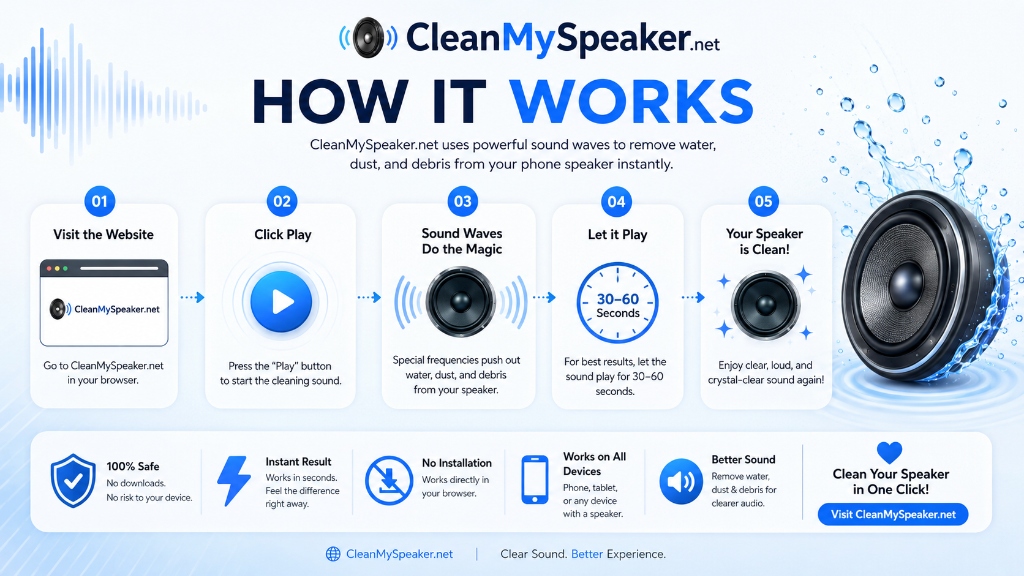
1. The Anatomy of a Smartphone Micro-Transducer
Modern mobile phones pack tiny dynamic speakers called micro-transducers. These speakers consist of:
An electromagnetic assembly that converts electrical audio signals into rapid physical linear motion.
A flexible polymer membrane that pumps air as the voice coil pushes and pulls it forward and backward.
A micro-perforated hydrophobic mesh designed to let sound waves pass while repelling dust and water.
2. Why Water Gets Trapped: Surface Tension
Water molecules have high cohesive forces, causing them to cling tightly together and form a dome or film across micro-perforations. When water splashes onto your phone, individual droplets seep into the exterior speaker openings and seal across the acoustic mesh pores.
Because this liquid film is airtight, it prevents sound waves from escaping into the environment, causing voices, music, and ringtones to sound severely muffled, distant, or crackly.
3. Why 165 Hz Is the Ideal Water Ejection Frequency
High-pitched sounds (such as 2,000 Hz or 5,000 Hz) vibrate very quickly, but with microscopic displacement. They barely move the air around them.
In contrast, low frequencies (between 130 Hz and 250 Hz, centered near 165 Hz) produce maximum cone excursion. This means the speaker cone travels its maximum possible distance forward and backward.
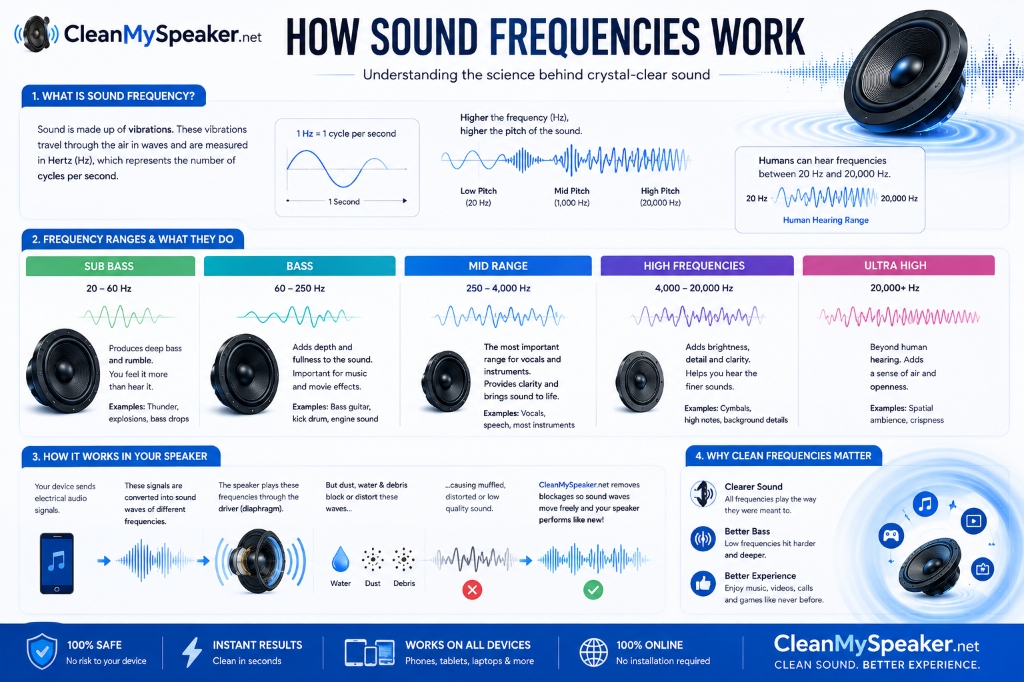
Understanding Frequency Ranges & What They Do
Produces deep rumble felt more than heard (thunder, explosions, sub drops).
Adds depth and fullness. 165 Hz creates peak mechanical excursion to physically expel moisture.
The most critical range for vocals, podcasts, speech clarity, and core musical instruments.
Adds brightness, fine details, and acoustic clarity (cymbals, high notes, consonants).
Beyond standard human hearing range. Contributes to spatial sense, airiness, and crisp harmonic realism.
The Air Displacement Effect
When the speaker diaphragm thrusts forward at 165 cycles per second, it pressurizes the small chamber behind the speaker grille. This sudden air pressure overpowers the liquid's surface tension, bursting the water film and propelling tiny water droplets out through the speaker holes.
4. Pure Browser-Synthesized Audio vs. Static MP3s
Many outdated websites use compressed MP3 or M4A audio files. These files often introduce compression artifacts, clipping, and lossy roll-offs that weaken low-frequency amplitude.
Clean My Speaker utilizes the modern HTML5 Web Audio API. Oscillators and gain nodes generate pristine, uncompressed mathematical waveforms directly inside your device's audio subsystem. This guarantees maximum acoustic energy is delivered to your smartphone transducer without compression degradation.
5. How to Position Your Device for Maximum Water Ejection
Face Downward: Position the speaker opening facing directly downward toward a table. Gravity works in tandem with the acoustic air pulses to guide droplets out.
Use an Absorbent Cloth: Rest the bottom corner of your phone against a dry microfiber towel. As moisture droplets emerge, the fabric immediately wicks them away.
Gentle Tap: During audio playback, gently tap the edge of your phone against the palm of your hand to help break stubborn droplets loose.
Acoustic Limits & Safety Notice
Sound vibrations can only move liquid that resides in or near the acoustic speaker chamber. If water has penetrated past internal rubber water-resistant gaskets and contacted the battery, logic board, or display connectors, sound waves cannot remedy the moisture. Read our Emergency Water Removal Guide for full immersion protocols, test your acoustic clarity with our Speaker Test tool, or browse our complete Audio Tools Suite. Learn about our project on our About page and read our full Privacy Policy.
Did Clean My Speaker Work For You? Share It!
Help friends, family, and followers eject water, remove dust, and fix muffled phone sound without paying repair shop fees.
Device Guides & Audio Tools
Our online acoustic cleaner is engineered to safely dislodge moisture and fine dust particles using pure sound physics.
Clean My Speaker
Play calibrated 165 Hz sound waves to clean my speaker, fix my speaker, and fix clean my speaker sound online. Eject trapped water and clear muffled audio with one click — no app download required.
Speaker Test
Test left/right stereo separation, full audio frequency range (100 Hz – 10 kHz), and detect speaker buzz, distortion, or blown hardware.
Remove Water
Dropped your phone in water? Follow this proven 5-step emergency protocol to safely eject trapped moisture and restore muffled sound.
iPhone Cleaner
Specialized guide and acoustic frequency tool for iPhone 15, 14, 13, 12, 11, and SE speakers.